By Dean McDonald, founder, Crane Rope Solutions
Why this matters
A fleet owner with a large group of crawler and all-terrain cranes asked us to review the periodic rope inspection reports from their third-party inspectors. They had written their own procedure for those inspections. When they audited seven vendors, none of them were following it.
“Rope inspection should not just be a matter of pass or fail. It’s generally predictable to a certain level.” (Dean McDonald)
What the reports were missing
- No method for “material loss”. CSA Z150 and ISO 4309 treat loss of metallic area and the change in diameter separately. A number labelled “material loss” with no method behind it can’t be used.
- No reference or nominal diameter. Without them, the reduction in diameter can’t be calculated.
- No winch identified. On a crane with two or more hoists, a reading without a winch is useless.
- No wire-break counts.
- Corrosion not graded. The reports said only “presence of dressing”.
- No construction or RCN. The rope category number decides how many broken wires are allowed. You can take it from the mill certificate, or work it out by counting the load-bearing outer wires.
What a good report records
| Item | Why |
|---|---|
| Crane, winch and rope position | Discard criteria change with location: drum zones, block, reverse bends |
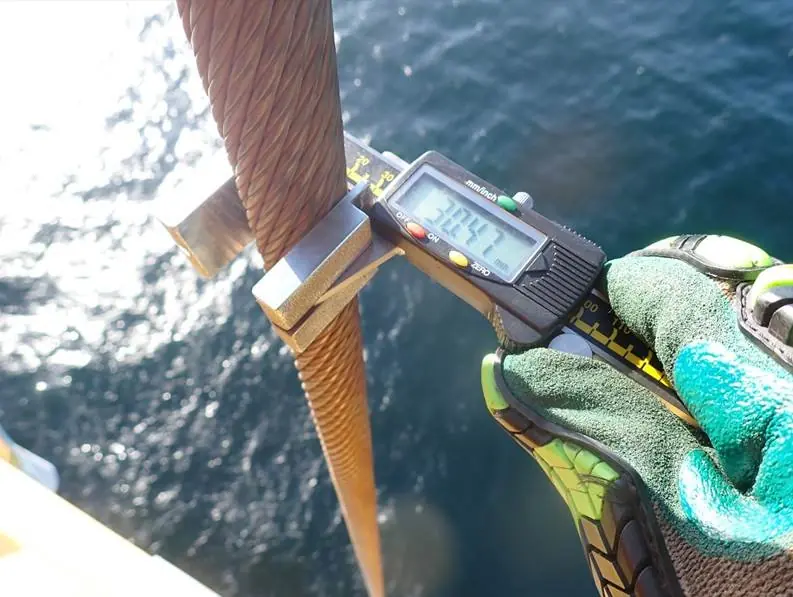
| Nominal diameter, OEM tolerance and reference diameter | Needed to calculate the reduction in diameter |
| Construction and RCN | Sets the allowable broken wires |
| Broken wires, with location and crown or valley | Counted over 6d and 30d |
| Corrosion, graded | External, internal, fretting |
| Deformation, by type | Waviness, crushing, bends, high strands |
| Total severity at each location | The discard decision |
Worked example: when nothing new is broken but the rope is still finished
On a 23 mm rotation-resistant hoist rope with an OEM tolerance of +2.8% to +3.6%, the new rope could measure about 23.82 mm. Say it now measures 23.04 mm. That is about 3.3% reduction, worth about 60% severity on its own. Add corrosion graded between superficial and high (60%) at the same location, and the combined severity is 120%. That rope is a discard even though no new wire breaks were found.
Reference diameter and actual diameter
In a shop inspection of a used 22 mm Lang’s lay hoist rope, the inspector found no diameter decrease. But no reference diameter had been recorded, and the mill certificate gave no actual diameter, so the reduction couldn’t be calculated at all.
“A reference diameter is a recorded measurement at the time of installation. The actual diameter is what is recorded on the cert.” (Dean McDonald)
“A comprehensive and valid inspection report is not possible without being provided the actual diameter or reference diameter.” (Dean McDonald)
The same rope had a “small kink” that the inspector had judged within the ISO 4309 waviness limit. It was a bend, not waviness.
“Waviness generally occurs over a longer section of the rope and is the result of altered rope geometry where the rope structure has tightened and forces a strand or strands out.” (Dean McDonald)
At a bend, compare the lay length with an unaffected section, and measure the diameter at two angles 90° apart. We also needed to know which end was the drum end and which the dead end, because the discard criteria change along the rope.
Use the reports to plan, not just to pass or fail
Compare reports on the same crane over time and you can forecast the change-out months ahead. Compare wear patterns across a fleet and you can choose a better OEM-approved rope next time.
“If we see a rope is fatiguing with crown wire breaks it might mean that we choose a rope with lower tensile grade next time to improve fatigue resistance.” (Dean McDonald)
Our discard calculator works through the ISO 4309 severity ratings for you.
Photos
More from the field: all case studies