By Dean McDonald, founder, Crane Rope Solutions
The situation
A 32 mm compacted, rotation-resistant Lang’s lay hoist rope was taken off a Liebherr 357 HC-L luffing tower crane that had been lifting loads of around 40 t out of a tunnel. It was shipped in on a skid for inspection.
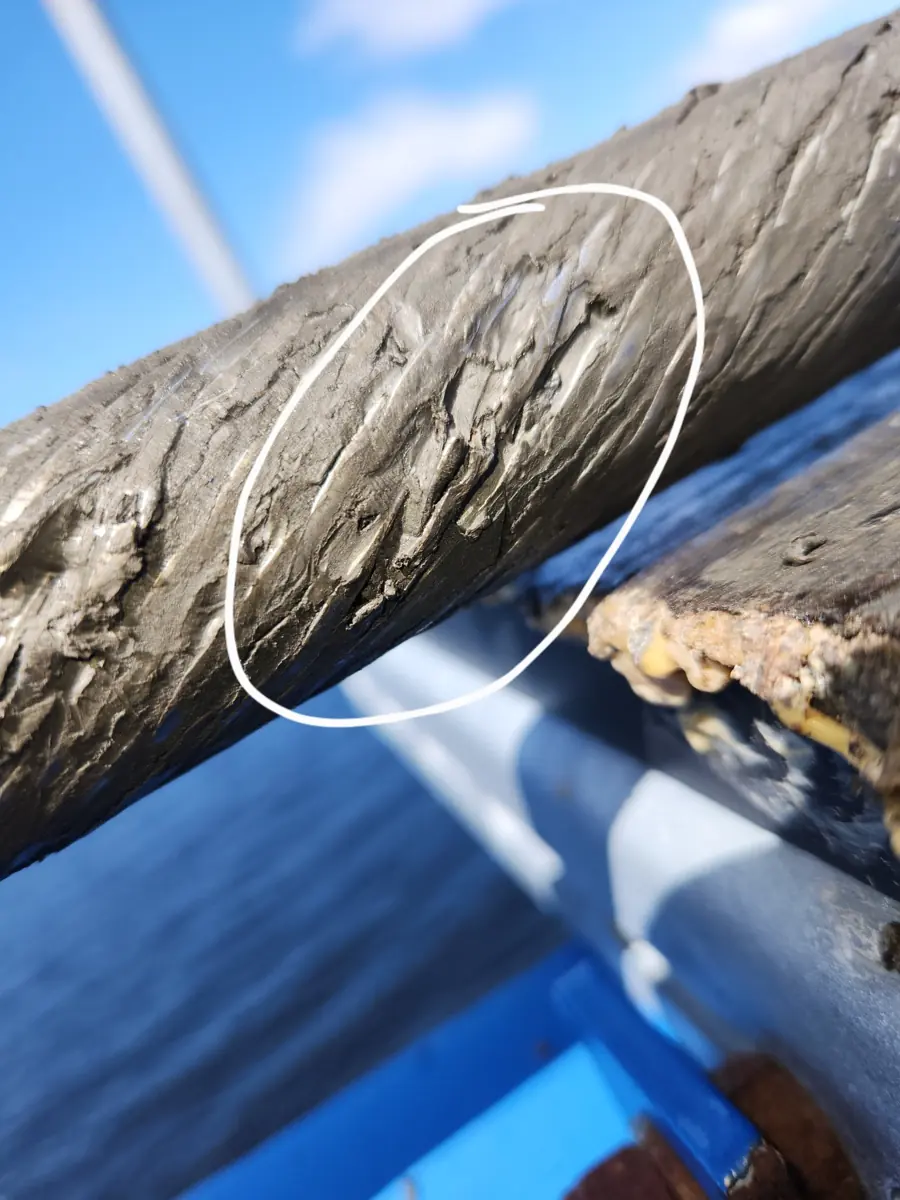
The inspector found two areas of flattened strands, at 434 ft and 583 ft from the drum, and broken wires at the thimble eye. Near the flat spots the rope measured 32.26 mm. The mill certificate gave 33.17 mm. ISO 4309 gives no discard for wear on its own when there are no broken wires, but the inspector was inclined to retire the rope anyway.
What the photos showed
The flattening was on the crown wires, in a drum cross-over zone. That is normal wear for a Lang’s lay rope on a multi-layer drum, not “excessive wear”. But it does suggest the rope wasn’t spooling properly.
“If the wire is only worn and not broken it will not count towards total discard criteria but of course its a good idea to monitor if the wear is concentrated in a single area.” (Dean McDonald)
Using the ISO 4309 formula, the decrease in diameter was (33.17 − 32.26) ÷ 32 = 2.8%, a 40% severity rating for a rotation-resistant rope. Not a discard on that alone.
The bigger problem: the rope started too big
At 33.17 mm, the rope was already above the OEM tolerance for that crane, which is 32.3 to 33.1 mm (+1% to +3.4%). That is a special tolerance: a standard +2% to +4% or 0 to +4% rope may not spool correctly on this drum.
“If the rope does not have .5% of clearance between actual diameter and the drum pitch the rope will get premature, lateral wear from spooling on the drum.” (Dean McDonald)
An oversize rope also changes the sheaves. A sheave that is still inside its ISO wear allowance may not fit a rope that is bigger than the OEM intended, which increases wear and the risk of birdcaging.
What we recommended
- Measure properly. Average two readings taken at 90° to each other and check them against the crane’s OEM tolerance and the mill certificate.
- If there are no broken wires, the diameter is in tolerance and total severity is under 100%: re-tension the rope and check the spooling. If it improves, slip and cut, and record it in the crane’s log book.
- Paint-mark the worn areas so you can match their position on the drum and sheaves to the trolley and hook position.
- Re-making the eye: break-test the actual thimble, sleeve and rope combination to prove the termination efficiency. Be careful with 2160-grade compacted ropes. In a break test we were involved in, a 2160 rope could not reach the required termination efficiency because the wire was too brittle.
- Don’t tension a rope that has torque in it. A rope that came off a figure-8 onto a reel can carry twist.
“I would not tension the rope as doing so with additional torque can permanently distort the rope geometry.” (Dean McDonald)
Install it untensioned as the OEM instructs. Then, with OEM approval, cycle it on and off the drum through a swivel to release the torque, or lay it out straight and respool it.
And clean the rope before you inspect it. ISO 4309 says grease and dirt must not hide the rope’s condition. That matters most on Lang’s lay rope, where breaks hide in the valleys.
Takeaways
- Flattened crown wires on a multi-layer drum are a spooling symptom first, and a discard question second.
- Check the new rope’s actual diameter against the crane’s own OEM tolerance, not a generic one.
- Diameter tolerance, drum pitch and sheave grooves have to agree. See diameter tolerance and how to measure drum pitch.
Photos
More from the field: all case studies