By Dean McDonald, founder, Crane Rope Solutions
Why pitch decides the rope
On a grooved multi-layer drum, the rope’s actual diameter has to sit just under the groove pitch. If it’s too big, the wraps fight each other and wear sideways. If it’s too small, the upper layers have room to move and crush the ones below.
Case 1: luffing tower crane, 34 mm hoist rope
A Potain MR 615 needed a new 34 mm hoist rope. The old one had been on since 2011. The drum holds about 650 m, with 400 m installed, 28 wraps per layer and 3 working layers.
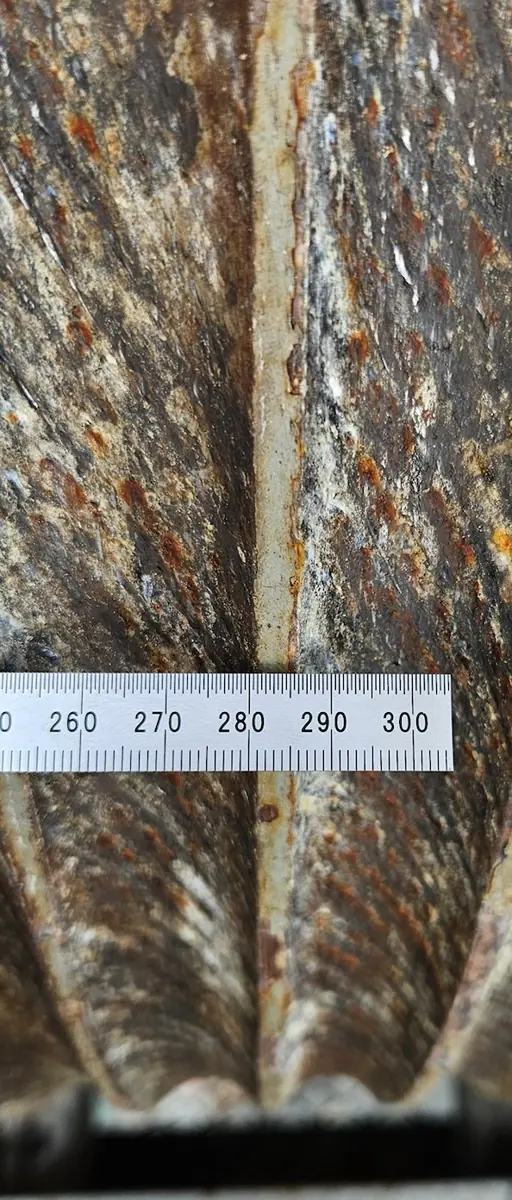
Measuring: we measured the pitch over 8 wraps and divided by 8, rather than measuring a single groove. It came out at 5% over nominal.
Choosing the tolerance: for a +5% pitch, we normally use a rope with a +2% to +4% tolerance, ideally about +4.5%, which leaves 0.5% clearance. The rope maker’s engineers went slightly further and target about 1% below the pitch: +4% for a +5% pitch, sold as +3.5% to +4.5%. The crane maker’s maintenance manual gives a minimum rope diameter of 0.5% to 2% below the drum pitch.
There is no exact formula, because the reduction in a used rope’s diameter varies along its length. Rotation-resistant ropes generally lose less diameter in service than non-rotation-resistant ropes. With only three layers, a small undersize was acceptable here.
Before installing: check the sheave grooves, because the old rope showed waviness, and clean the drum grooves with a wire brush on a grinder.
Case 2: a metric rope on an imperial drum
A haulage winch drum was grooved for a 1-5/8 in rope: a groove radius of 22.225 mm and a pitch of 47.625 mm. No imperial rope was available, so the question was whether a 42 mm rope would fit.
- Groove radius: the rope maker’s rule is 0.525 to 0.550 × the rope diameter. For a 42 mm rope that is 22.05 to 23.10 mm, so 22.225 mm fits.
- Lay direction: a right-hand drum takes a left-hand lay rope.
- Strength: the drawings required a minimum breaking force of 132 t (1,174 kN). The 42 mm rope gave about 470 kN more.
- Sheaves: these needed a groove of at least 44.5 mm for the 42 mm rope, about 6% over nominal. The newly rebuilt sheave was too small. See sheaves that don’t fit the rope.
Takeaways
- Measure pitch over several wraps, and measure the new rope’s actual diameter before it goes on.
- Aim for the rope’s actual diameter to sit about 0.5% to 1% under the pitch.
- When you change from imperial to metric, check groove radius, lay direction, breaking force and the sheaves.
Photos
More from the field: all case studies