By Dean McDonald, founder, Crane Rope Solutions
Why the type of break matters
Crown breaks are on the outside of the strands, where the rope bends over sheaves and the drum. Valley breaks are between strands, and they point to wear or failure inside the rope. ISO 4309 treats valley breaks much more seriously: two or more in one rope lay length (about 6 rope diameters) is a discard.
Case 1: three breaks, no type given
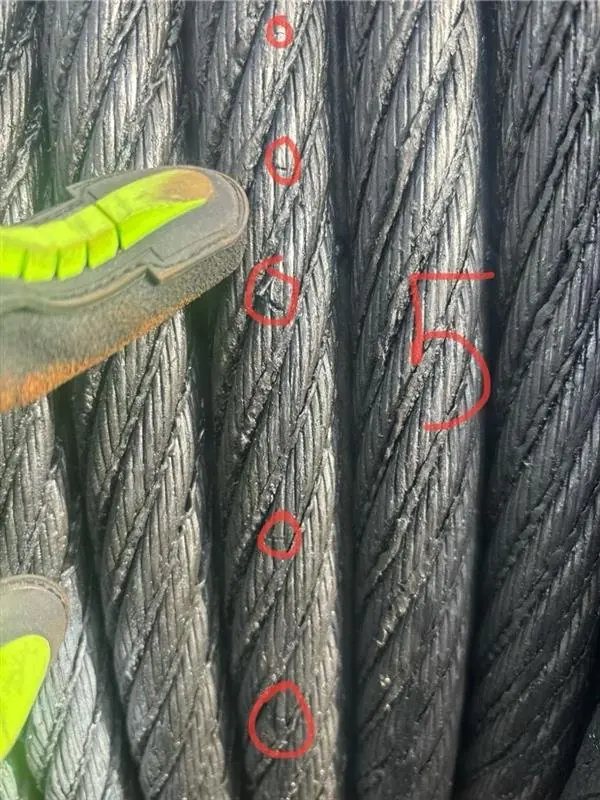
A third-party report on an offshore crane’s luffing rope listed three broken wires without saying whether they were crown or valley breaks.
“I do not see 2 valley breaks in 1 lay length to meet discard criteria, but I would prefer the opinion of the experts!” (Dean McDonald)
The rope maker’s engineers confirmed they were crown wire breaks. Magnetic rope testing (MRT) wasn’t needed. They recommended removing the broken wire ends, by bending them back and forth until they snap, so they can’t damage the neighbouring wires.
Case 2: “numerous valley breaks”, crane about to shut down
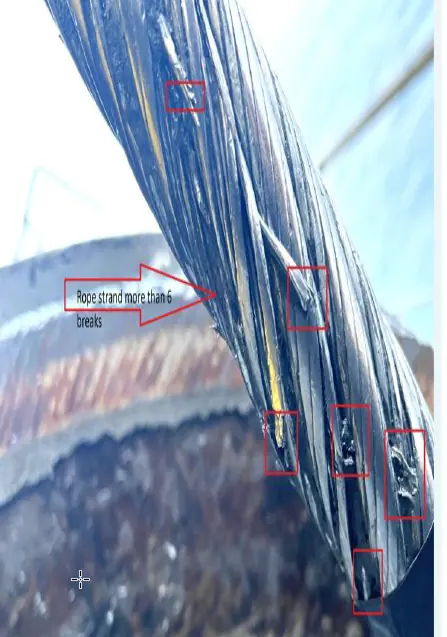
On another crane, inspectors reported numerous broken wires, including valley breaks, on a 42 mm Lang’s lay luffing rope. The operator was ready to shut the crane down.
“The customer’s inspectors reported some valley wire breaks but I can’t tell if these are indeed valley breaks or just Lang’s lay crown breaks.” (Dean McDonald)
After a joint meeting with the rope maker, the answer was clear. A technician had snipped off protruding crown-wire breaks the day before, and the cut ends looked like valley breaks to the next inspector.
The worked numbers (ISO 4309, RCN 09, multi-layer drum):
| Check | Found | Limit | Result |
|---|---|---|---|
| Broken wires over 6d | 10 | 18 | 56% of discard |
| Diameter | 41.98 mm average (41.81 and 42.14 mm at 90°) against a reference of 43.3 mm | - | 3.1% reduction, not a discard |
A later re-inspection put the rope at about 45% of discard, and the crane OEM’s representative agreed. The rope stayed in service, and its change-out was planned for the following weekend.
Lessons
- Record crown or valley for every break.
- If you remove broken wire ends, write it in the maintenance log so the next inspector doesn’t misread the cut ends.
- Measure diameter with wide-jaw calipers that span at least two strands, and average two readings taken at 90°.
- See what a rope inspection report should include.
Photos
More from the field: all case studies