By Dean McDonald, founder, Crane Rope Solutions
Case 1: crawler crane, “the rope is twisting excessively”
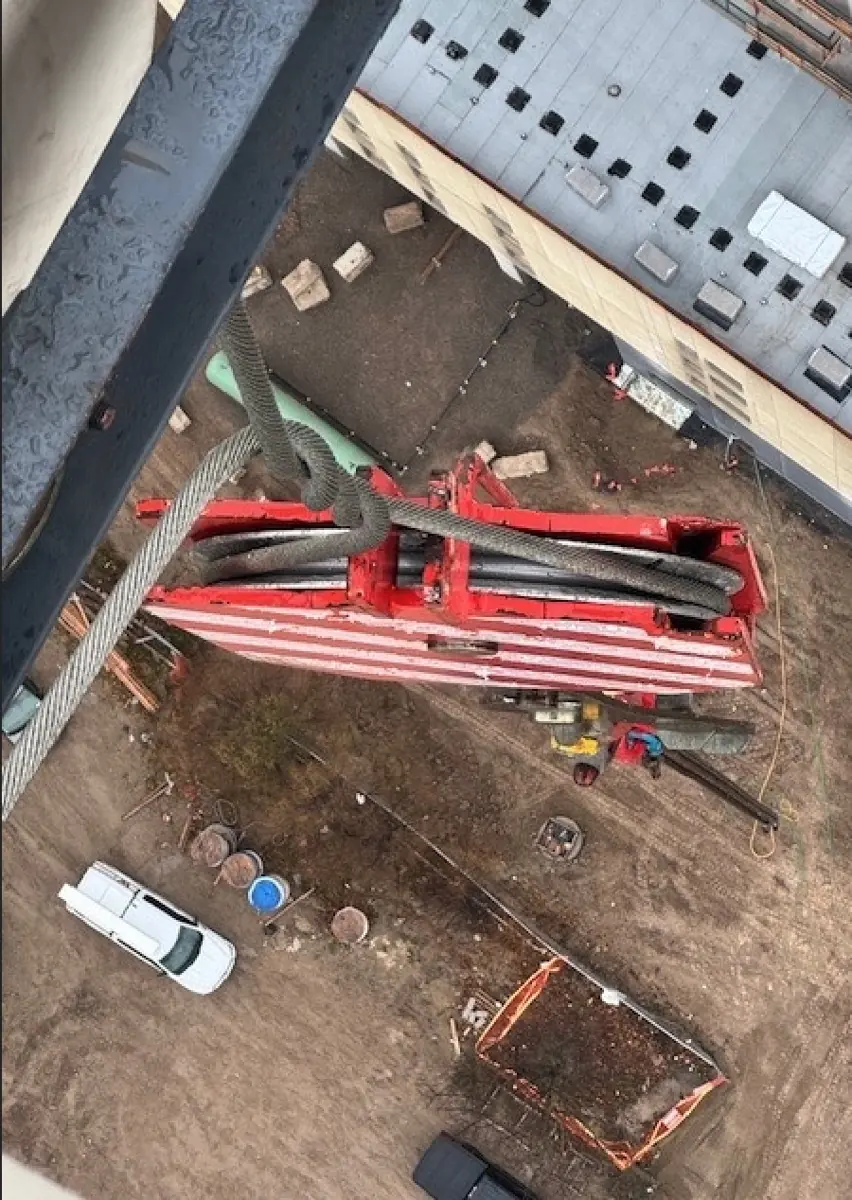
The owner of a Manitowoc 14000 with a 26 mm rotation-resistant hoist rope wanted to fit a swivel because the rope was twisting badly.
Our advice: don’t install a swivel for lifting unless the crane OEM approves it. If a rotation-resistant rope twists under load, there is torque in the system, either from installation or from a change in the rope’s geometry.
“If the swivel is actively rotating while a lift is being made it means that the rope is rotating from the inside and this can lead to unexpected catastrophic failure.” (Dean McDonald)
The order we suggested for the investigation:
- Check the mill certificate and the age of the rope.
- If the rope is new, check the sheaves, and confirm the rope matches its certificate and the OEM specification (+1% to +3% on this crane).
“When the new rope is larger than older rope, worn sheaves could cause the block to twist when load is applied.” (Dean McDonald)
- Then consider installation. With OEM approval, a temporary swivel can release installation torque before you go back to the OEM termination. Or lay the rope out on clean ground and re-reeve it.
- If the rope is old, check its diameter and lay length at several points along it for internal problems.
What it turned out to be: a service technician found that the riggers had been over-twisting the rope to line up the wedge socket with the boom connection, and the rope wasn’t run out far enough during testing. The sheaves and the rope were fine. One option is to ask the OEM about a positioning swivel at the socket, used only to align it, as some models have from the factory.
Case 2: gantry crane, block spinning at 65 m
A gantry crane had two identical hoists. One was re-roped with a 20 mm 8-strand rotation-resistant rope; the OEM had specified a 6-strand fibre-core rope, which local regulations don’t allow for hoisting. With a light load at 65 m lift height, the block twisted, and it got worse with heavier loads. Laying the rope out straight and reinstalling it didn’t help. The crane was down and the owner asked for a refund.
On site we measured the rope and gauged the sheave grooves. Some sheaves were tight and worn, and the wear differed between the two hoists, which suggested the crane wasn’t as new as reported. On one hoist the groove measured almost 26 mm for a 20 mm rope, so it was probably the wrong sheave.
“After going to site I found some tight sheaves which I think may be the cause of the unwanted block rotation.” (Dean McDonald)
The rope maker confirmed the sheaves were very worn and out of tolerance. Its guidance is a groove of 5% to 10% over nominal (21 to 22 mm for a 20 mm rope) and a sheave hardness of 240 to 300 HB. The claim was withdrawn.
Takeaways
- A spinning block is a symptom. Look for torque from rigging and installation, and for tight, worn or wrong sheaves, before blaming the rope or adding a swivel.
- Gauge every sheave before a new rope goes on. See sheave gauges.
Photos
More from the field: all case studies