By Dean McDonald, founder, Crane Rope Solutions
What happened
On a Bauer BG45, the last two wraps on the main (kelly) winch drum went loose. They climbed over the kicker, came back down, and broke wires on the last wrap near the drum dead end.
Shorten or replace?
The damage was in one place, near the dead end, but the rope still had to be inspected to ISO 4309 along its whole length. The rope maker confirmed that ISO 4309 applies here.
“If the rope does fail, my plan is to inspect the rest of the rope and if it is ok, we will shorten, serve, braze and taper the rope behind the damage.” (Dean McDonald)
The rest of the rope passed. It was shortened behind the damage and re-ended: served, brazed and tapered.
The second find: negative imprints in a crowd sheave
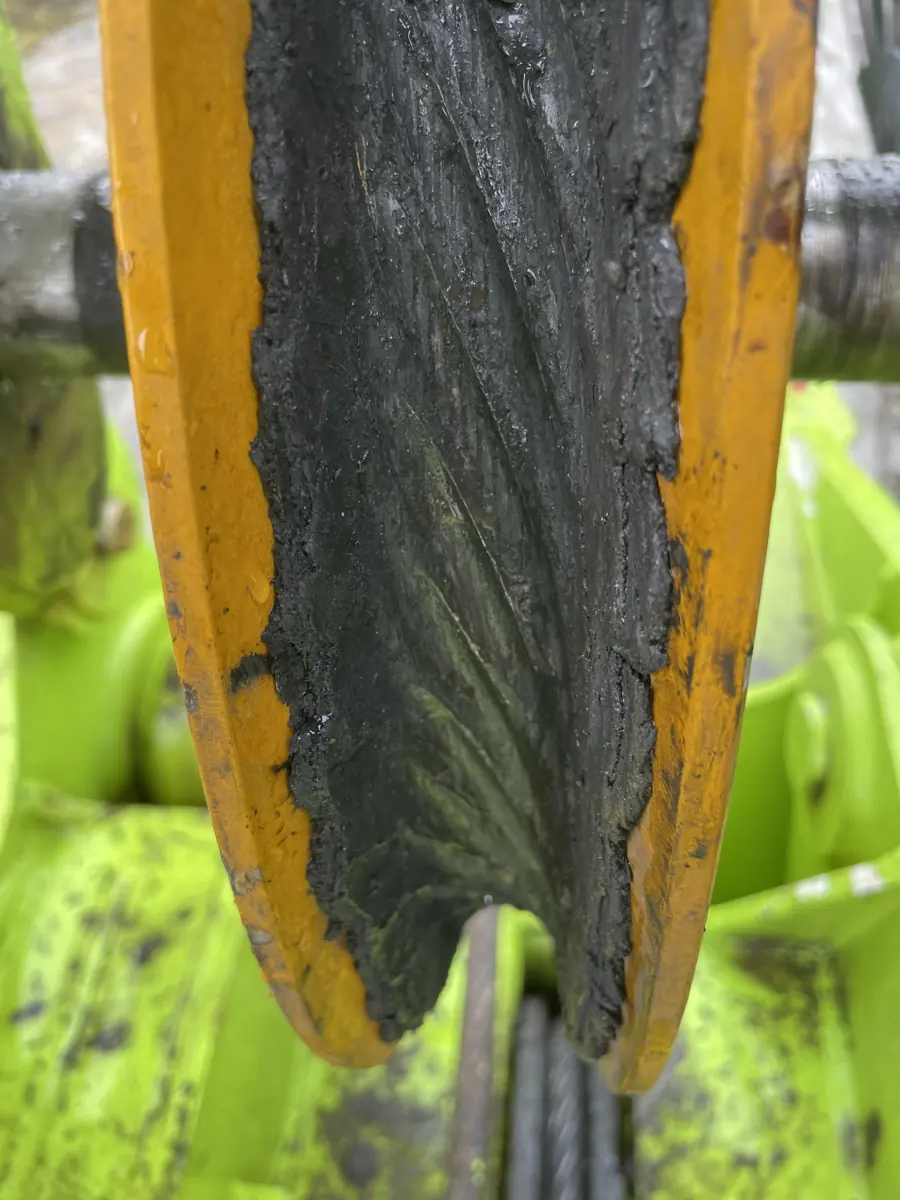
On the same visit, one of the crowd system sheaves had negative rope imprints worn into the groove: the pattern of the old rope cut into the steel. That explained why the crowd ropes weren’t lasting. A sheave like that has to be replaced before a new rope goes on.
“We would not install a new rope onto this old sheave.” (Dean McDonald)
A worn crowd sheave at 8,168 hours
On a BG55 at 8,168 hours, we found a crowd-system fleeting sheave that was badly worn.
“I agree that the issue is 100% preventable, yet all too common for my marketplace.” (Dean McDonald)
A rope distributor’s technician on the job suggested a simple routine:
- Make a groove gauge at the nominal rope diameter plus 5%. For a 28 mm rope that is a 29.4 mm disc.
- Check every sheave every 6 months, every 500 hours, and before every rope change. It takes about 3 minutes a sheave.
- Use OEM sheaves for this duty, because the material and bearings are chosen for it. Changing the rope type alone won’t fix a worn sheave.
Takeaways
- Localized damage near the dead end doesn’t always mean a new rope. Inspect the full length first.
- Negative imprints in a groove mean a new sheave.
- See the kelly and crowd rope guide for what should end a kelly rope’s life.
Photos
More from the field: all case studies