By Dean McDonald, founder, Crane Rope Solutions
The situation
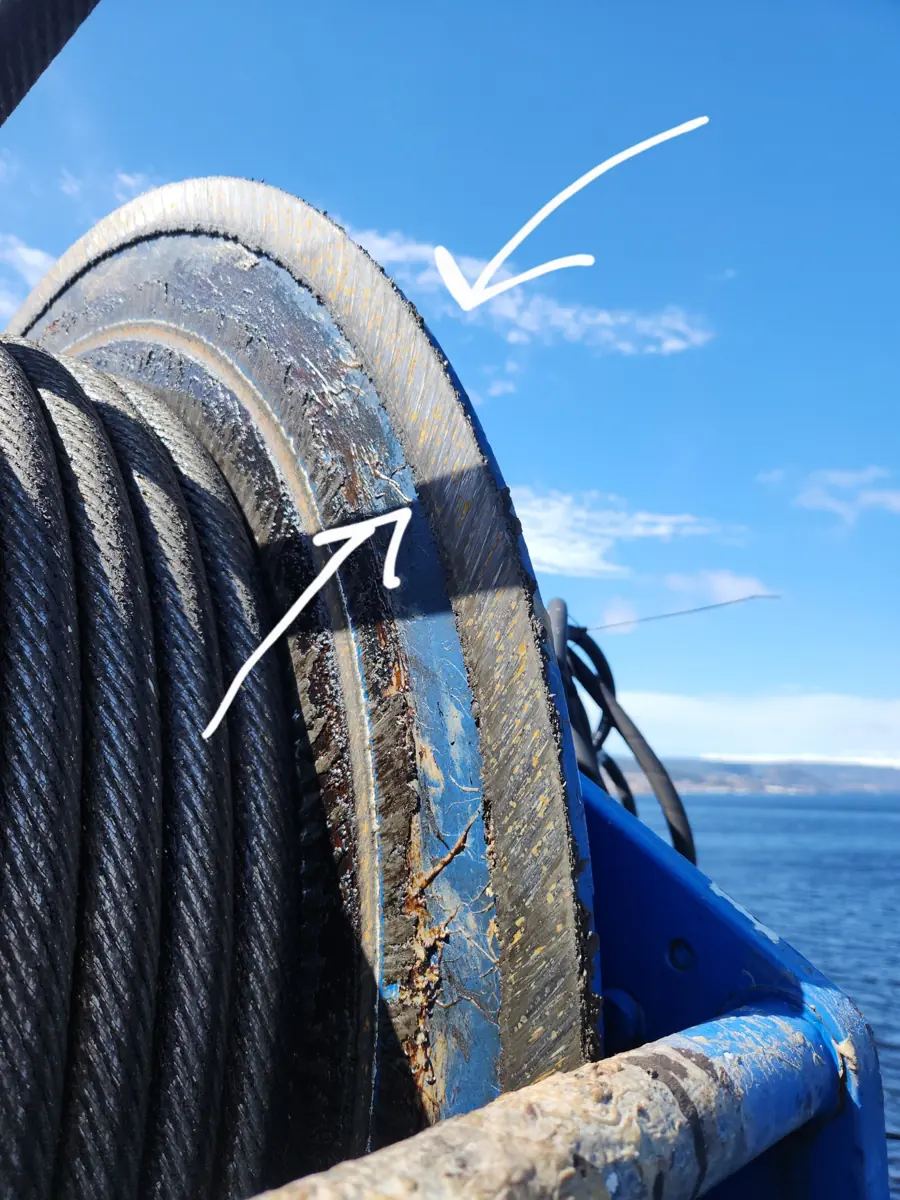
On a Liebherr harbour crane, the 34 mm rotation-resistant hoist rope was being retired after about 18 months and fewer than 900 hours, with crushing on the first wrap and broken wires. The rope before it hadn’t lasted as long. The drum flange was also badly worn, and a new one was ordered from the OEM.
What we found at the drum
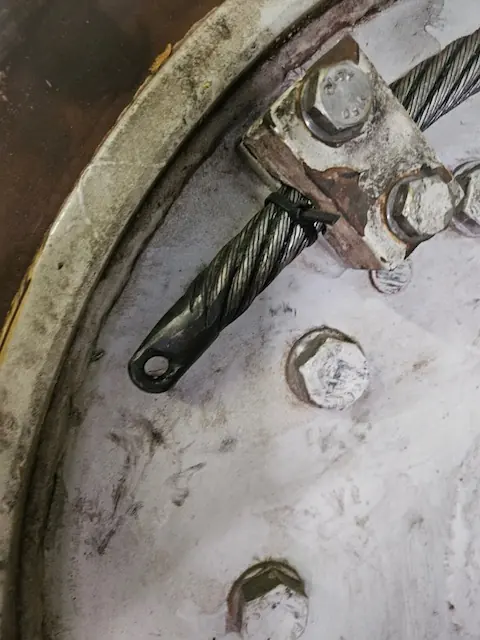
The rope’s dead end wouldn’t seat in the drum clamp, so the rope had been running without being fully secured. The OEM gave the dead-end hole as about 44 mm. The crew measured 40.5 mm with an inside micrometer, which still left more than 10% clearance for a 34 mm rope. So the hole wasn’t the problem.
When the crew took the rope off, they found the secondary clamp flange was bent and blocking the rope. They removed the bent flange, seated the rope in the main clamp and re-tensioned it. The OEM has the final say on the clamp arrangement.
Why an unsecured dead end wrecks a rope
A dead end that isn’t secured and tensioned lets the rope stretch and relax with every load cycle. That creates a sawing action on the rope and the drum, and a rough drum surface makes it far worse.
“If it’s rough or even sharp to the touch with your hand, you can almost guarantee its having at least some impact on rope longevity.” (Dean McDonald)
We’ve also seen ropes wrecked by putting torque into them with a come-along at the dead end. It is more common with non-rotation-resistant ropes, but the same applies to rotation-resistant ones.
“The rope should be able to be mounted into place without using additional mechanical force to pull it into place.” (Dean McDonald)
What else we asked for
- Gauging of the block and boom-tip sheaves.
- Cleaning and relubrication on a schedule.
- Logging hours against this rope:
“Please ensure that it’s written in the log book along side the total engine or preferably winch hours on this rope specifically.” (Dean McDonald)
Other factors may also have shortened this rope’s life. A correctly seated dead end, a repaired flange and a smooth drum come first.
Takeaways
- Short life with damage near the drum: check the dead end, the flange and the drum surface before changing rope type.
- Never force a rope into its anchor with a come-along.
- Record winch hours for each rope. It is the only way to tell whether a fix worked.
Photos
More from the field: all case studies