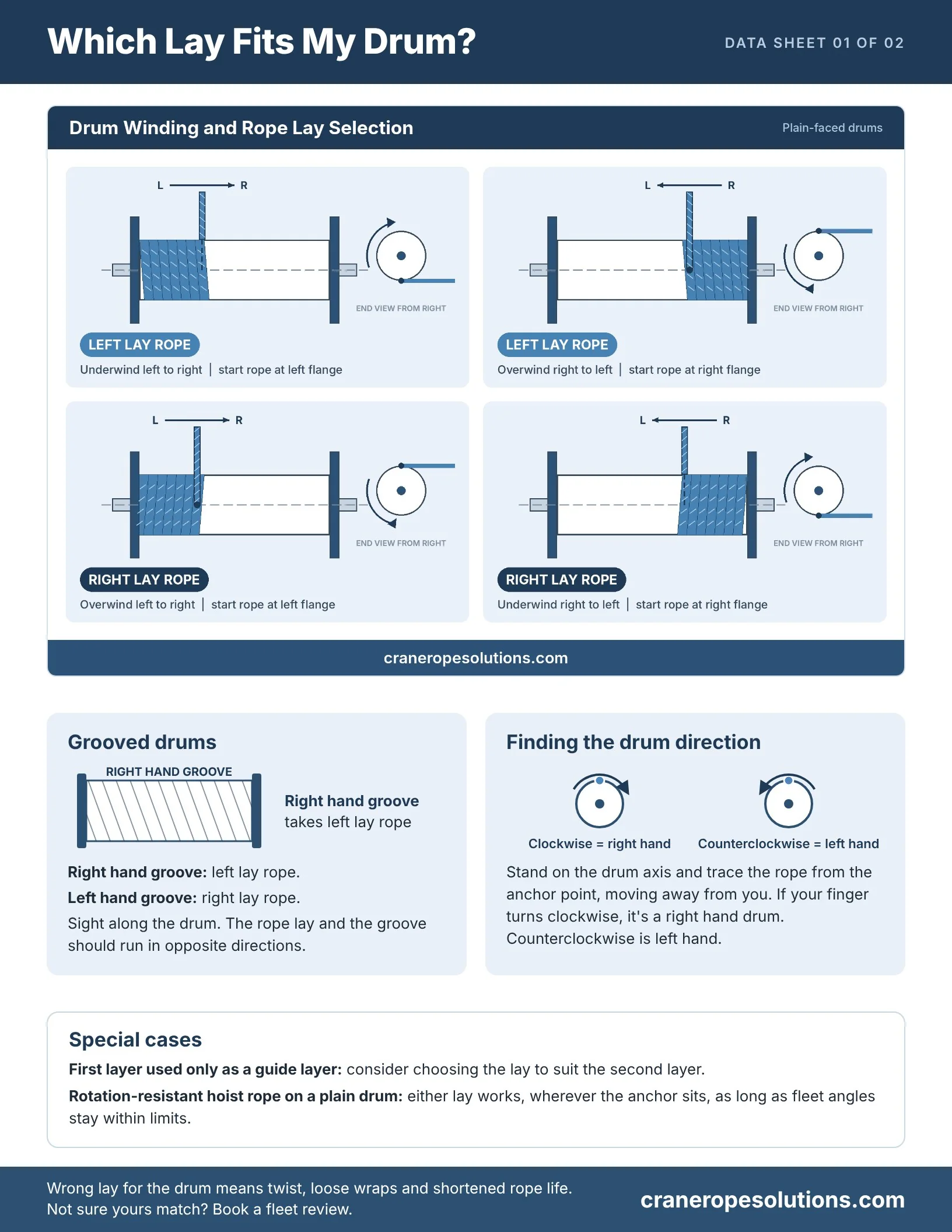
Which lay fits my drum?
Plain-faced drums
Overwound means the rope comes off the top of the drum. Underwound means it comes off the bottom. On a plain-faced (smooth) drum, the lay that winds tight against the flange is:
| Drum winding | Start the rope at | Rope lay |
|---|---|---|
| Overwind, left to right | Left flange | Right lay |
| Overwind, right to left | Right flange | Left lay |
| Underwind, left to right | Left flange | Left lay |
| Underwind, right to left | Right flange | Right lay |
Grooved drums
- Right hand groove: left lay rope.
- Left hand groove: right lay rope.
Sight along the drum. The rope lay and the groove should run in opposite directions.
Finding the drum direction
Stand on the drum axis and trace the rope from the anchor point, moving away from you. If your finger turns clockwise, it’s a right hand drum. Counterclockwise is left hand.
Special cases
- First layer used only as a guide layer: consider choosing the lay to suit the second layer.
- Rotation-resistant hoist rope on a plain drum: either lay works, wherever the anchor sits, as long as fleet angles stay within limits.
Wrong lay for the drum means twist, loose wraps and shortened rope life.
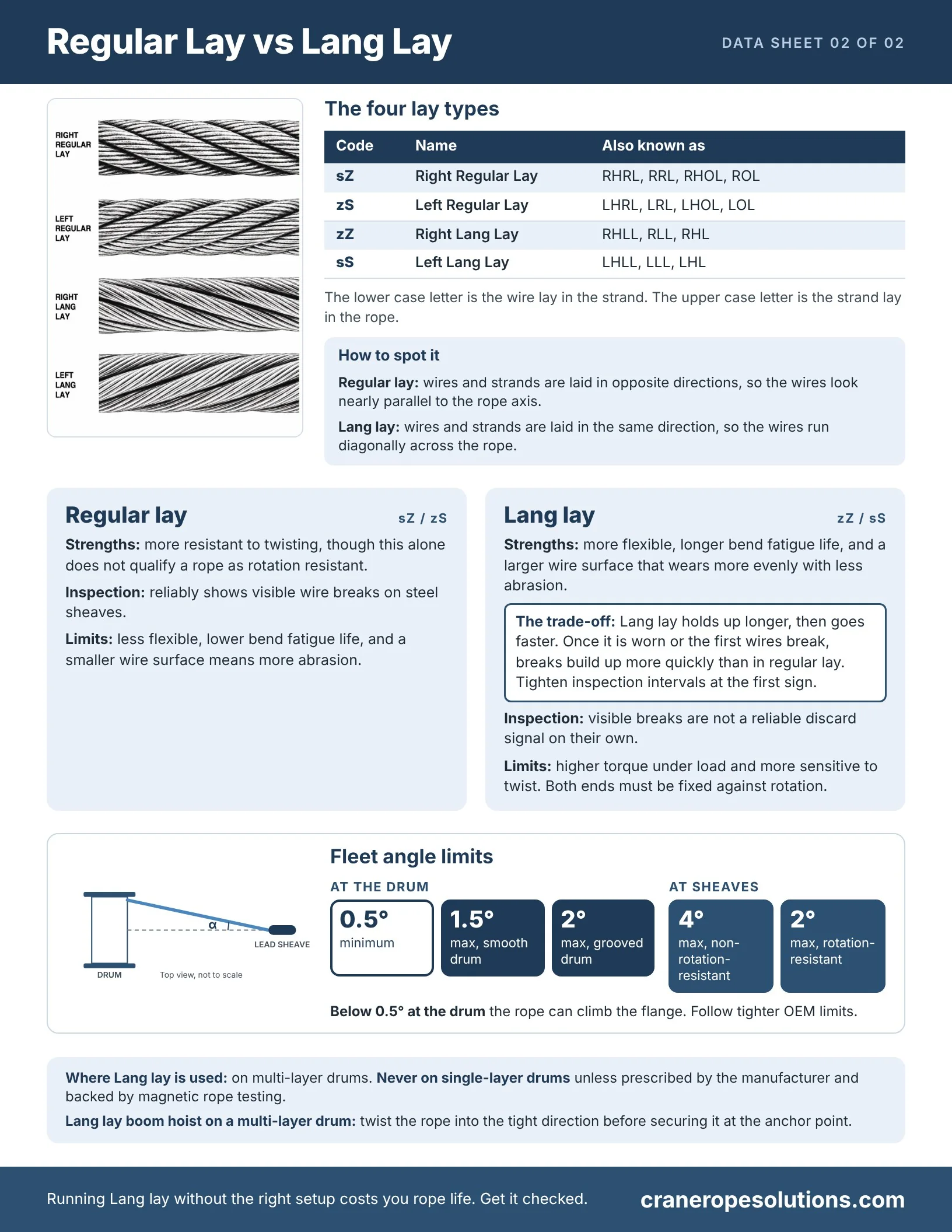
Regular lay vs Lang lay
The four lay types
| Code | Name | Also known as |
|---|---|---|
| sZ | Right Regular Lay | RHRL, RRL, RHOL, ROL |
| zS | Left Regular Lay | LHRL, LRL, LHOL, LOL |
| zZ | Right Lang Lay | RHLL, RLL, RHL |
| sS | Left Lang Lay | LHLL, LLL, LHL |
The lower case letter is the wire lay in the strand. The upper case letter is the strand lay in the rope.
How to spot it
- Regular lay: wires and strands are laid in opposite directions, so the wires look nearly parallel to the rope axis.
- Lang lay: wires and strands are laid in the same direction, so the wires run diagonally across the rope.
Regular lay (sZ / zS)
- Strengths: more resistant to twisting, though this alone does not qualify a rope as rotation resistant.
- Inspection: reliably shows visible wire breaks on steel sheaves.
- Limits: less flexible, lower bend fatigue life, and a smaller wire surface means more abrasion.
Lang lay (zZ / sS)
- Strengths: more flexible, longer bend fatigue life, and a larger wire surface that wears more evenly with less abrasion.
- The trade-off: Lang lay holds up longer, then goes faster. Once it is worn or the first wires break, breaks build up more quickly than in regular lay. Tighten inspection intervals at the first sign.
- Inspection: visible breaks are not a reliable discard signal on their own.
- Limits: higher torque under load and more sensitive to twist. Both ends must be fixed against rotation.
Fleet angle limits
| Where | Limit |
|---|---|
| At the drum | 0.5° minimum |
| At the drum, smooth drum | 1.5° maximum |
| At the drum, grooved drum | 2° maximum |
| At sheaves, non-rotation-resistant rope | 4° maximum |
| At sheaves, rotation-resistant rope | 2° maximum |
Below 0.5° at the drum the rope can climb the flange. Follow tighter OEM limits.
Where Lang lay is used
On multi-layer drums. Never on single-layer drums unless prescribed by the manufacturer and backed by magnetic rope testing.
Lang lay boom hoist on a multi-layer drum: twist the rope into the tight direction before securing it at the anchor point.
Running Lang lay without the right setup costs you rope life. Get it checked.
Related: Right-hand or left-hand lay rope? · Spooling tension · Diameter tolerance and drum pitch · Free rope inspection checklists